Time to Value
1 afternoon
Time to first allocation

CloudPi is the FinOps platform that allocates costs without waiting for tags, executes savings instead of just recommending them, and verifies every dollar against your actual bill. One platform. Multi-cloud. Finance-grade proof.
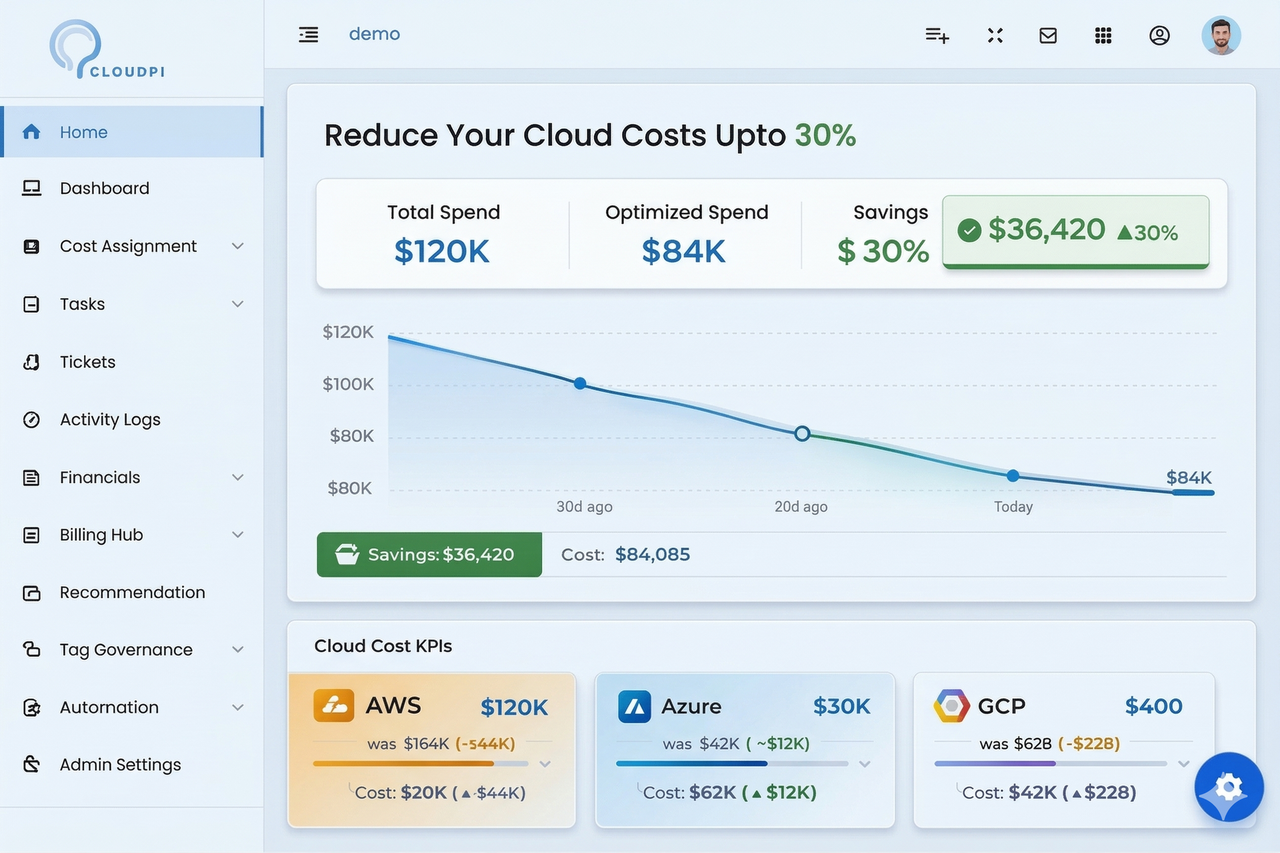
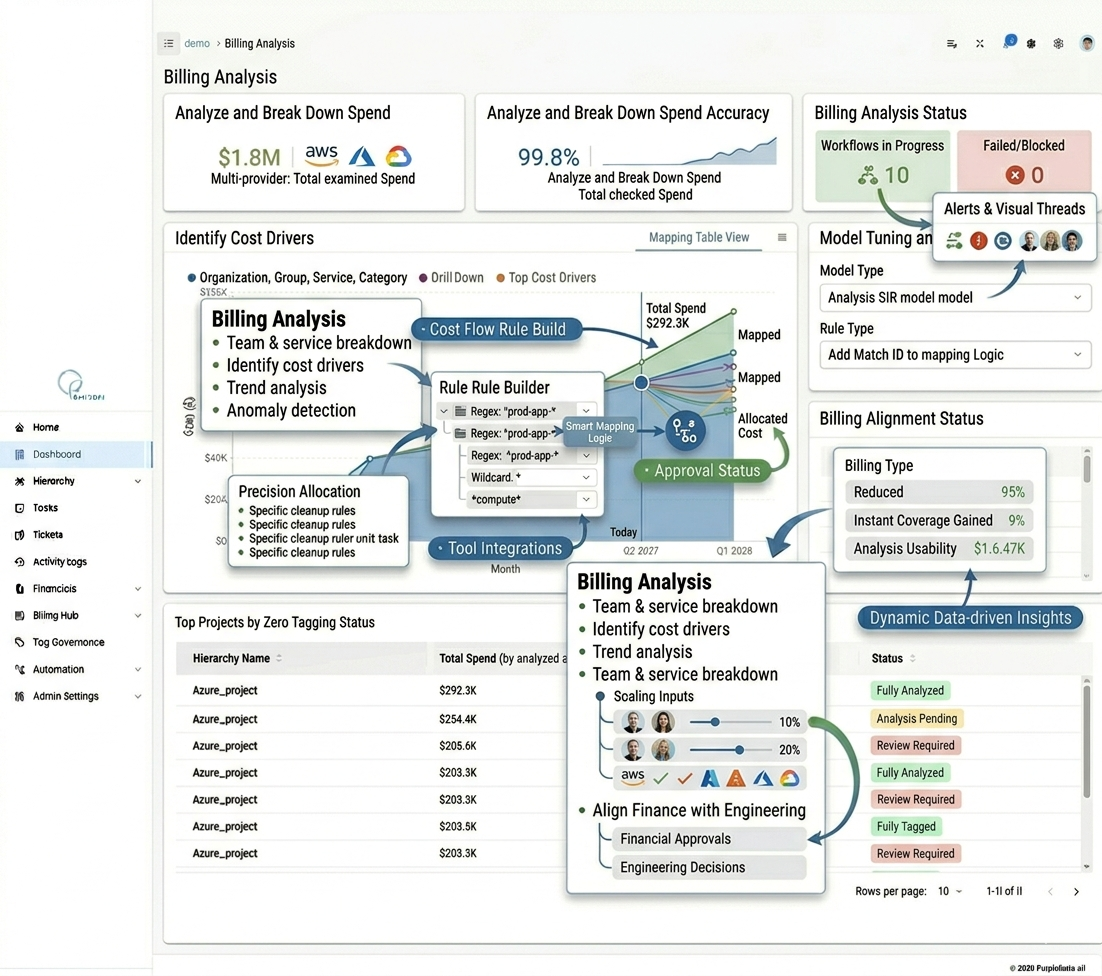
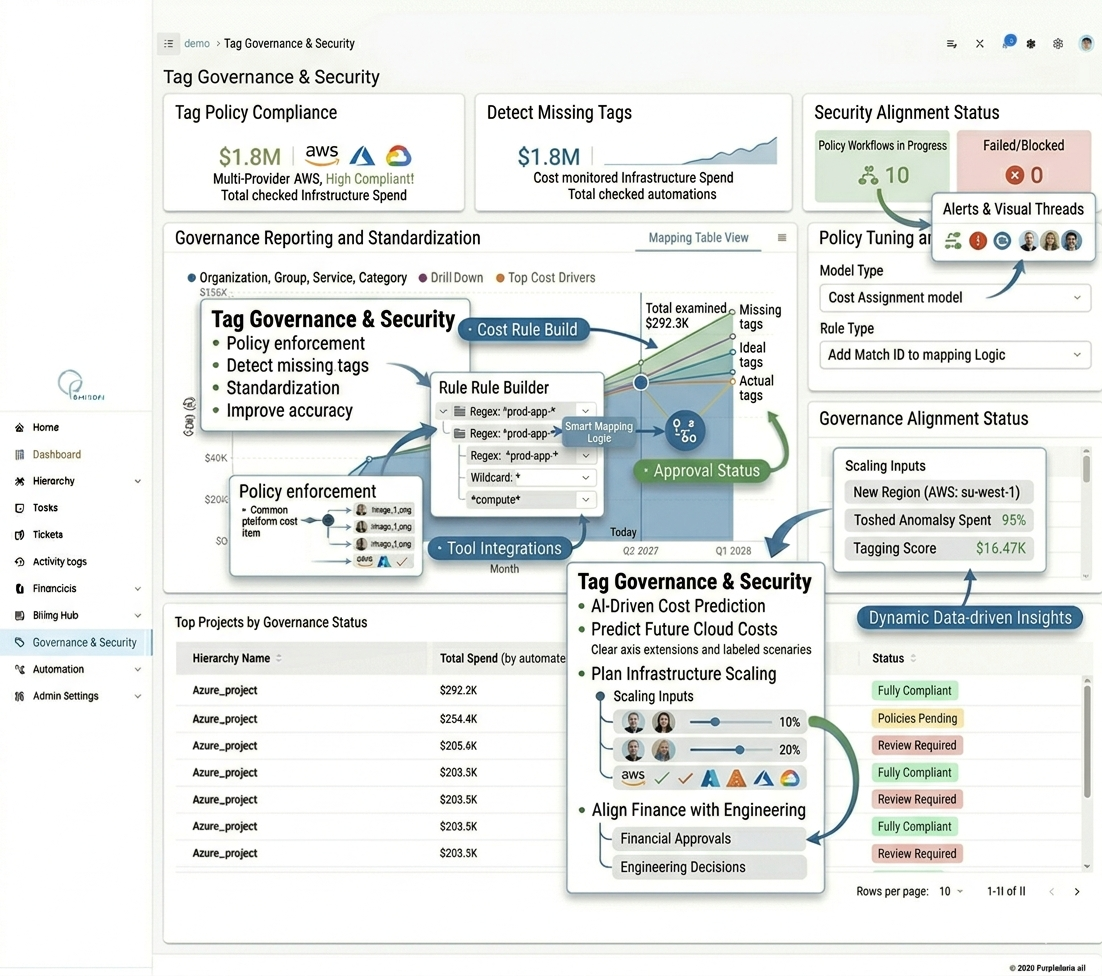
Immediate ownership visibility without waiting for full tag compliance.
Before-and-after billing evidence, attributed savings, and auditable action history for finance review.
Most cloud cost platforms stop at dashboards and potential savings. CloudPi is built to change the bill, not just annotate it.
Most cloud cost platforms work the same way. Connect billing data. Review dashboards. Surface recommendations. Email engineering teams. Follow up. Repeat.
The result is not just missed optimization. It is a credibility problem. The CFO stops trusting the savings number, engineering tunes out another vague request, and FinOps becomes a reporting function instead of an operating system.
The issue is not finding waste. It is getting from insight to actual remediation.
The issue is not producing savings claims. It is verifying them with finance-grade evidence.
It allocates early, executes savings through policy-driven workflows, and verifies outcomes against the actual bill so teams can move from visibility to action to proof.
These are the clearest competitive wedges in the platform story and the strongest reasons to keep scrolling.
Most FinOps tools require 85% tagging compliance before cost allocation begins. CloudPi allocates 80-90% of cloud costs in one afternoon using five non-tag signals: account structure, naming patterns, service ownership, IAM metadata, and usage data.
One afternoon to 84% allocation. Not six months.
See how it works →CloudPi supports autonomous remediation, approval-gated automation, and ticket plus enriched context from the same workflow engine. One rule can behave differently in dev, staging, and production.
Every mode feeds the same TRUE Savings ledger.
See the full pipeline →CloudPi reports TRUE Savings that are verified with billing data, auditable through a complete evidence chain, and attributed to the policy, team, and engineer responsible for the result.
No mixing tiers. No inflated totals. Numbers your CFO will trust.
See the methodology →Each capability works independently. Together, they form a closed loop: allocate costs accurately, analyze spend patterns, optimize with automated execution, govern with policy enforcement, and secure everything with enterprise-grade access controls.
| Allocate | Analyze | Optimize | Govern | Secure |
|---|---|---|---|---|
| Cost Assignment Rules | Billing Analysis | Automated Savings Execution | Tag Management | Enterprise RBAC |
| Business Hierarchy | Billing Anomaly Detection | Intelligent Schedulers | Workflow Automations | SSO + Audit Trail |
| Zero-Tag Day-One Allocation | FinOps KPIs | Three Remediation Modes | Budget & Forecast | Approval Workflows |
| TRUE Savings Verification |
Every step generates data that feeds the next, which is why the page reads like one connected operating model instead of separate feature blurbs.
CloudPi starts with allocation because the rest of the FinOps stack gets more useful once ownership is visible.
Every FinOps team hits the same wall: "We cannot allocate costs until we fix tagging." CloudPi was designed with a different premise. Tags make allocation better. They do not make it possible.
CloudPi uses five non-tag signals to attribute costs immediately, then layers tag-based precision on top when tags are available. The result is 80-90% allocation accuracy in one afternoon instead of a multi-month dependency on tagging compliance.
The counterintuitive benefit is that teams start tagging faster once they can already see their costs. Tagging shifts from compliance theater to self-interest.
| Signal | How it works | Typical coverage |
|---|---|---|
| Account structure | Map AWS accounts and Azure subscriptions to business units. | 40-60% |
| Resource naming patterns | Use wildcard and regex matching on resource names. | +15-25% |
| Service-level rules | Map dedicated services to owning teams. | +5-10% |
| IAM and usage metadata | Infer ownership from who created and uses a resource. | +5-10% |
| Tags | Layer tag-based rules on top for additional precision. | +5-15% |
Rule-based cost assignment for shared services, clusters, and cross-team infrastructure.
Shared Kubernetes clusters, cross-account networking, and platform services used by six teams do not allocate themselves, and spreadsheets do not scale. CloudPi's rule-based cost assignment engine supports filters, pattern matching, allocation targets, priority ordering, and automatic execution every billing cycle.
Example: a $47,000 per month shared Kubernetes cluster can be allocated across four teams by namespace usage, with proportional fallback for untagged pods. When Team Echo launches in Q3, one new rule handles it. No spreadsheet surgery.
Read the deeper cost assignment story →Map cloud accounts to the structure finance and leadership already use.
CloudPi lets you map cloud accounts to your actual business structure: organization, business unit, department, team, and project. A single account can belong to a cost center and a product line and an environment at the same time.
When teams merge, projects sunset, or new business units launch, you update the hierarchy once and let reports, dashboards, budgets, and access controls update automatically.
Read more about business hierarchy →The analytics story is not just visibility. It is faster answers, earlier detection, and a KPI layer leadership can actually use.
Unified billing analysis with trends, comparisons, budgets, and forecasts.
CloudPi puts multi-dimensional billing analysis in one place with cost breakdowns, trend analysis, month-over-month comparison, budget tracking, and forecast analysis. The CFO asks why spend went up. You answer in one click instead of a week-long archaeology project.
Read more about billing analysis →Catch billing anomalies early with baseline modeling, deviation scoring, and waste detection.
CloudPi detects billing anomalies before they compound using ML-based baseline modeling, deviation scoring, and alerting for immediate spikes, trending increases, and waste detection. Catching a $500-per-day anomaly on day 1 instead of day 21 is the difference between a lesson and a write-off.
Read more about anomaly detection →| KPI category | What it measures | Examples |
|---|---|---|
| Coverage | What percentage of spend is allocated, tagged, and committed. | Tag compliance, allocation completeness, commitment coverage. |
| Optimization | How effectively provisioned resources are actually being used. | Rightsizing adoption, scheduling coverage, waste elimination. |
| Unit economics | What the business pays per unit of output. | Cost per transaction, customer, or deployment. |
Built-in FinOps KPIs for coverage, optimization, and unit economics.
CloudPi builds the FinOps Foundation's KPI framework directly into the platform so leadership can assess program maturity without waiting on a three-day slide-building exercise.
Read more about FinOps KPIs →This is the operational center of the page: CloudPi is positioned as an execution platform with workflow, control, and proof.
An automated execution pipeline that routes approvals, runs actions, and verifies savings.
The fundamental problem with most FinOps platforms is that they are recommendation engines, not execution platforms. CloudPi automates the savings pipeline end to end.
Approvals route through Jira, Azure DevOps, or ServiceNow. Execution happens through direct cloud API integration. Verification compares billing data before and after each action.
Read more about automated savings →| Metric | Manual process | CloudPi |
|---|---|---|
| Recommendations surfaced | 1,358 | 1,358 |
| Actions approved | 412 (30%) | 1,181 (87%) |
| Actions executed | 248 (18%) | 1,181 (87%) |
| Verified monthly savings | $14,200 | $67,500 |
| Time to capture | 30+ hours per month analyst time | Automated |
One policy engine with three control levels matched to environment risk.
Not every resource has the same risk tolerance. CloudPi supports three remediation modes within the same policy engine:
The same policy can run in different modes per environment. Autonomous in dev. Approval-gated in staging. Ticket plus enriched context in production.
Read more about remediation modes →| Resource type | Environment | Mode |
|---|---|---|
| Idle instances | Dev and staging | Autonomous |
| Oversized instances | Production | Approval-Gated |
| Orphaned snapshots | All | Autonomous |
| Database refactors | All | Manual |
| Savings Plan purchases | Not environment-specific | Approval-Gated |
Intelligent schedulers cut non-production waste with usage-aware automation.
CloudPi's intelligent schedulers automate start, stop, and scaling based on real usage patterns. Business-hours scheduling, distributed-team support, calendar awareness, and exception handling let teams reduce non-production spend without introducing operational risk.
Example: a 24-instance EC2 development environment drops from $18,400 per month to $7,100 per month, a 61% reduction, without engineer intervention after setup.
Read more about intelligent schedulers →Billing-verified savings methodology with attribution and a finance-ready evidence chain.
Most cloud cost tools report theoretical savings. CloudPi's TRUE Savings methodology reports what changed on the actual bill, preserves an evidence chain for finance review, and attributes outcomes to the policy, team, and engineer responsible for the action.
TRUE Savings is always reported in three separate tiers so finance does not have to untangle mixed-value claims.
Read more about TRUE Savings →| Tier | What it measures | Example |
|---|---|---|
| Tier 1 - Hard Savings | The bill went down due to a specific action. | Right-sizing, scheduling, terminations. |
| Tier 2 - Rate Savings | The same resources ran at a lower rate. | RI, SP, and EDP commitments. |
| Tier 3 - Cost Avoidance | Spend that would have occurred was prevented. | Auto-scaling guardrails and shutdown policies. |
The governance layer turns manual follow-up work into systems, escalation paths, and measurable compliance.
Continuous tag governance with scanning, enforcement, and compliance tracking.
CloudPi makes tag governance a system instead of a wiki. Teams define required keys, allowed values, and naming conventions at the right scope, then continuously scan for violations, identify gaps, and enforce compliance through notifications, blocking rules, or auto-remediation.
Read more about tag management →Policy-driven workflows with triggers, conditions, escalation, and TRUE Savings tracking.
CloudPi's workflow engine replaces manual follow-ups with policy-driven automation. Every workflow follows the same pipeline:
That means autonomous remediation for low-risk actions, approval-gated execution for higher-impact changes, and enriched tickets with resource IDs, cost impact, metadata, playbooks, and deep-links when teams need to implement manually.
Example escalation chain: untagged resource detected, resource owner notified immediately, manager escalated at 48 hours, VP escalated at 120 hours, and auto-tagged as non-compliant at 168 hours.
Read more about workflow automations →Daily budgets and rolling forecasts that surface overruns before month-end.
CloudPi updates budgets daily and continuously forecasts end-of-period spend based on current burn rate and historical patterns. Set budgets at any level, configure early warning thresholds, and investigate the dimensions that moved when actuals diverge from forecast.
Read more about budgets and forecasting →The security story supports the finance-grade promise: controlled access, approval boundaries, SSO, and audit-ready history.
Hierarchy-scoped RBAC, SSO, approval controls, and immutable audit history.
CloudPi's RBAC is built for compliance requirements, multi-tenant operations, and separation of duties. It supports seven built-in roles, hierarchy-scoped access, configurable approval workflows, SSO through Okta, Azure AD, SAML 2.0 or OIDC, and a searchable immutable audit trail.
Proof point: one SOC 2 auditor asked three questions about financial data access controls, and all three were answered in under 60 seconds using RBAC exports and audit logs.
Read more about enterprise RBAC →| Role | Access level | Typical users |
|---|---|---|
| Viewer | Read-only dashboards | Engineering ICs, contractors |
| Analyst | View and export reports | FinOps analysts, senior engineers |
| Team Lead | Manage team budgets and approve team actions | Engineering managers |
| BU Admin | Full control over their business unit | VP Engineering, Director of Infrastructure |
| FinOps Admin | Full access to all FinOps features | FinOps team |
| Finance | All cost data, read-only | Finance business partners, FP&A analysts |
| Executive | High-level dashboards only | CFO, CEO, board-level stakeholders |
All major features stay consistent across providers, so teams do not have to build a separate operating model for each cloud.
CloudPi connects to billing data across AWS, Azure, and GCP. Cost assignment, anomaly detection, scheduling, savings execution, budgets, and RBAC all work consistently across providers with one hierarchy and one dashboard.
| Capability | AWS | Azure | GCP |
|---|---|---|---|
| Cost ingestion | CUR and Cost Explorer | EA, MCA, CSP | Billing Export |
| Account mapping | AWS Organization | Management Groups | Organizations |
| Resource scheduling | EC2, RDS, ECS | VMs, SQL, AKS | Compute, SQL, GKE |
| Savings execution | EC2, EBS, RDS, S3 | VMs, Disks, SQL | Compute, Disks, SQL |
| Tag governance | Resource tags | Resource tags | Labels |
This comparison section crystallizes the page's positioning by contrasting typical FinOps tools with CloudPi's execution-first model.
| Dimension | Typical FinOps tool | CloudPi |
|---|---|---|
| Day-one allocation | Requires tags first, which creates a 3-6 month delay. | 80-90% allocation with zero tags. |
| Savings approach | Recommendations only. | Recommendations plus automated execution. |
| Execution rate | 15-25% through manual follow-up. | 85-90% through an automated pipeline. |
| Savings verification | Potential savings estimates. | TRUE Savings that are billing-verified, auditable, and attributed. |
| Remediation control | One-size-fits-all or nothing. | Autonomous, approval-gated, or enriched-ticket remediation per policy. |
| Time to value | Months. | One afternoon. |
The getting-started story is explicit, operational, and easy to visualize on a landing page.
Connect your AWS Organization, Azure Management Group, or GCP Organization. CloudPi discovers all accounts and their structure automatically in about 15 minutes.
Map cloud accounts to business units, departments, and teams in roughly one hour through bulk import or an interactive setup.
Create cost assignment rules using account mappings, naming patterns, and service-level ownership. Coverage is previewed before activation.
Dashboards populate immediately. Costs are allocated, anomalies are detected, savings opportunities are identified, and ongoing policies can be layered in over time.
The page clearly serves both operators and decision-makers, which is why the role section matters for conversion.
Gets automated cost allocation, savings execution, KPI dashboards, and tag governance, and avoids spending 20 hours a month in spreadsheets.
Gets team-level cost visibility, budget tracking, and optimization recommendations scoped to the resources they actually control.
Gets business-unit spend oversight, approval workflows for high-impact changes, and compliance-ready operating controls.
Gets verified savings with billing proof, budget forecasting, and audit-ready exports that stand up in finance review.
Book a 30-minute demo and we will show you exactly where your money is going with rules, not spreadsheets. Or start on your own with a trial and see the allocation process end to end.